

Each year at our rookie onboarding night, when young players and their parents came in for an induction, my short introduction set out broad expectations before the coaches and technical staff briefings.
“At this young age, you must decide if team sports is really for you,” I started. “If you continue on this journey, you will need to relinquish self and trust this coach and this organisation—always. You will have to subject some of your freedoms for the greater good. You will have to fit into our culture, lift to our character standards and required behaviours, and put the team first.
“You and your parents will need to make this commitment if you want to join our team. The coach may not give you the minutes you think you deserve. He may not give you any minutes at all.
“If you are uncomfortable, then quit and pursue an individual sport.”
With individual sports you lose the camaraderie of a team, but you have full control. It doesn’t matter if you are a good person or not. It doesn’t matter how you get things done. It doesn’t matter how you eat, how you sleep, how much you drink, or how you train. Efforts and character don’t matter—only results do.
Whether the world loves you or hates you, it’s how fast you run the 100-metre sprint when it counts that decides if you make the Olympics and even win the gold medal. The same with singles tennis, boxing, MMA, or even chess.
“You are either a team player or you’re not!”
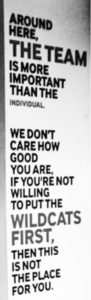
We had a two-storey sign at our entrance which simply said:
AROUND HERE, THE TEAM IS MORE IMPORTANT THAN THE INDIVIDUAL. WE DON’T CARE HOW GOOD YOU ARE. IF YOU’RE NOT WILLING TO PUT THE WILDCATS FIRST, THEN THIS IS NOT THE PLACE FOR YOU.
The Spectrum of Team Players
One of the biggest mistakes in recruiting is not identifying the character fit for team players and team performance. Every person sits on a spectrum that ranges from team-first all the way to the lone-wolf maverick—individuals – fundamentally unsuited for team environments due to their psychological makeup, which predisposes them to create conflict, erode trust, and prioritise personal goals over collective success, making them a net liability in collaborative enterprises.
Simply put, they don’t play well with others.
Paulhus and Williams first conceptualised this at the start of the century in their Dark Triad theory, triangulating narcissism (constant need for attention and admiration), Machiavellianism (manipulative, deceptive, self-goal-oriented), and psychopathy (lack of empathy and remorse).
Whilst we may grimace at these characteristics, in the right mix they do work well for solo sports but can be easily misplaced on a team. Their abrasive, competitive, and self-reliant nature suits individual pursuits or highly autonomous professional roles—where success doesn’t depend on group cohesion.
Interestingly, people with some of these Dark Triad traits also gravitate towards leadership. It takes a certain level of self-confidence to consider oneself better than those around you and to nominate yourself as their leader, despite all the science supporting servant leadership as the proven model.
When maverick personalities assume positions of authority, their traits often manifest as demanding, autocratic, and toxic leadership styles that may occasionally produce short-term results but at unsustainable interpersonal costs, damaging morale and causing employee burnout.
This is why the best leaders are chosen, not self-appointed. History is full of examples, and the evidence stacks up for itself.
What Makes a Good Team Player?
Contrary to more recent popular team theory, agreeableness is not the panacea.
In fact, functioning teams require high levels of candour and contrarianism.
In our experience, interdependence, forgiveness, and flexibility are three key ‘team-first’ traits to look for. Additionally, people who score highly on generosity, patience, kindness, empathy, fairness, and sentimentality help balance teams, especially when there are occasional alpha-leaning players.
The H³ Leadership Framework: Screening Out Mavericks at the Source
The most effective strategy for managing maverick personalities is preventing their recruitment into collaborative team environments altogether.
Good leadership requires setting the baseline for what is an acceptable level of selfish behaviour on the team and guarding that line diligently—regardless of how talented the maverick is.
Coaches, managers, and leaders may sometimes feel tempted to break this rule for what appears to be a unicorn player, believing they can coach the Dark Triad out of them.
But as many have found out the hard way, the odds are against you. That’s why they are called ‘coach killers’.
Screening for Dark Triad players is not complicated. They are typically low on honesty, humility, and hard work (H³). Rarely, if ever, have we found a person who scores in the top percentiles of these three characteristics to be problematic in any collaborative environment.
Honesty as the Antidote to Machiavellianism
The H³ Framework’s emphasis on honesty provides powerful defence against Machiavellian manipulation. Research shows strong negative correlations between the honesty-humility dimension and Dark Triad traits.
Structured behavioural interviews exploring ethical dilemmas, rule-bending, or responses to colleague misconduct reveal Machiavellian tendencies. Honest candidates provide straightforward answers and demonstrate discomfort with deception, whilst Machiavellian individuals rationalise unethical behaviour.
Humility as the Counter to Narcissism
Humility—characterised by modesty, appreciation for others, and accurate self-assessment—directly counters narcissistic grandiosity and entitlement, effectively screening out individuals whose inflated self-image would create competitive, credit-stealing environments.
Questions about handling mistakes, sharing credit, responding to criticism, or taking on non-starring roles expose narcissistic tendencies. Humble candidates readily acknowledge others’ contributions and accept responsibility for failures, whilst narcissists struggle, steering credit back to themselves.
Hard Work as the Screen for Psychopathy
Hard work—related to conscientiousness—screens for subclinical psychopathy’s most destructive traits: impulsivity, lack of long-term ambition, and unreliability. Prioritising candidates with consistent diligence, perseverance, and accountability filters out reckless, counterproductive behaviours.
Examining track records for sustained effort and completed long-term projects reveals conscientiousness, whilst psychopathic traits manifest as abandoned projects and inconsistent work histories.
Implementation and Proper Placement
Organisations should integrate assessments of honesty, humility, and hard work throughout recruitment, with reference checks and structured interviews targeting each dimension. Critically, organisations must resist compromising H³ standards for impressive technical skills—exceptional talent doesn’t compensate for team damage.
Individual contributor roles with high autonomy suit mavericks better than collaborative positions. However, promoting mavericks into leadership positions over teams warrants exceptional caution. Leaders with Dark Triad traits create toxic environments, erode trust, and increase burnout and turnover—a high-risk, often destructive model to avoid.
We have used this framework for over a decade in recruiting team players, coaches and c-suite leaders.
If you’d like to take advantage of this intelligence with your next hire, please contact us on +61 8 6377 7607 or email saarrah@marvinHR.com.
Alternatively, you can access the marvinScout and screen for these characteristics yourself.